
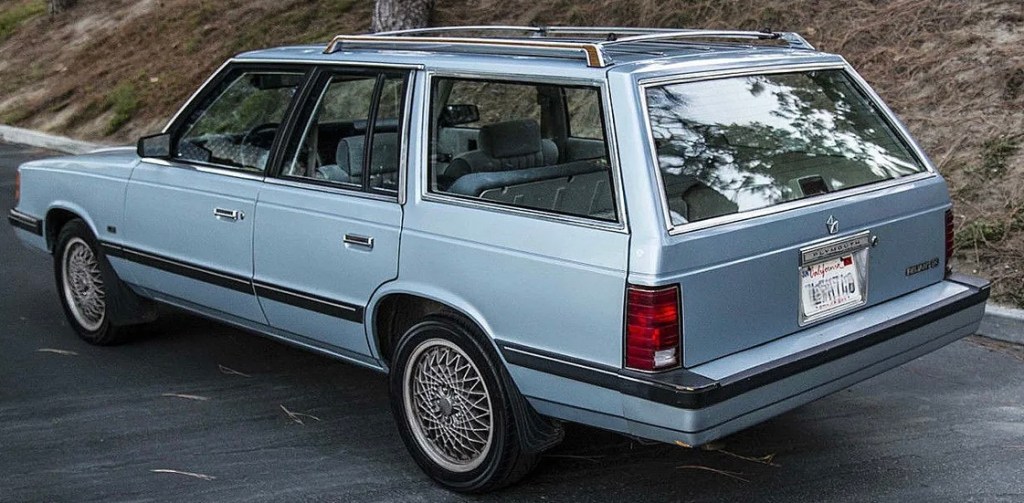
Significant transitions have been a common theme for me, and like all other pivotal events in my life, each transition is connected to a song. “Here’s Where the Story Ends” was the number one song on the Billboard Modern Rock Chart when I rolled into Columbia, Missouri in May of 1990 behind the wheel of my 1893 Plymouth Reliant, with my most trusted companion at my side, a boombox of the same vintage. At the time, this melancholic track from The Sundays was the ideal transition song for my mind, which was plagued by a little souvenir of a terrible year. With everything I owned in the back of my powder blue Reliant wagon of the same vintage as my listening device, I chose to drive forward, to leave 1989 and Los Angeles in the rearview mirror. At the age of 20, I had decided to leave the entertainment industry, to look forward, and only forward, genuinely believing I would forget my terrible souvenir of 1989 as I drove into a new city, a new decade, and a new career path.
My plan in 1990 was to earn a degree at the University of Missouri School of Journalism. I would then document the sound of Gen X as we entered adulthood, which would lead to a long and successful career as a trailblazing female music journalist in the 21st century. Like any aspect of the music business, there were a scant few women doing this work in the 1990s. A career in writing was the path that my teachers had been advising me to take since Mrs. Ruby Brown sent a letter to Grandma Lane when I was in the sixth grade. In an envelope with a postmark from December 1980, (a correspondence which I did not know existed until after my grandma passed away nearly thirty years later) Mrs. Brown had mailed a neatly handwritten story I’d composed when I was eleven. A gold star sticker, next to 100% ! written in such a way to convey Mrs. Brown’s great pleasure in reading my story, were both in the top margin of the first page. The envelope also contained a notecard from my teacher expressing that she believed I had a gift for writing and asking my family to encourage me to attend college and pursue a writing career. In seventh grade, Mrs. Rieck would pull me aside after English class one day, to tell me she’d like to help me with scholarship applications to ensure that I would be able to afford to attend college when the time came. By the time I was sixteen, my high school journalism teacher, Mrs. Roberts, was offering to write a letter of recommendation, emphatically stating she believed I could attend the prestigious School of Journalism at the University of Missouri on full scholarship.
But at eighteen, I had other plans. I wanted a career in the entertainment industry as a fast track to earning a living that would create a more comfortable and less complicated life for my mom and my brother. My mom had struggled so much emotional abuse from a man I have never met because he abandoned us upon the awareness of my forthcoming existence. My brother had been born blind and had already endured multiple surgeries and treatments in order to see at a bare minimum, just enough to be able to attend public school by the time he was five years old. Because my height and my commercially-viable appearance could support and enhance their lives, I began to prepare myself for a career as a fashion model. A large part of that plan involved preparing myself mentally for such a massive transition from eighteen years of life in my tiny rural Midwestern town to living in Los Angeles. I had to become fearless, so I composed a mixtape of empowering songs. During the months leading up to my high school graduation, I listened to my tape every night, and continued to do so every night after I moved to LA, until the tape wore thin and eventually broke. Track 1, side A was Janet Jackson’s 1986 hit single “Control.” Janet was a young woman just a year older than me. I had watched her grow from the shy younger sister of the 1970s phenomenon, The Jackson Five, who had crossed over boundaries of generation, race, and musical genre, with multiple number one pop and R&B singles, under the vigilant, and as some believe, violent, tutelage and management of their father. At eighteen, Janet chose to abandon the family business model to take control of her own career. I was awed and inspired. Three weeks after graduating from high school, I denounced all scholarships and accepted a modeling contract with the the Nina Blanchard Agency in Los Angeles. I believed I was in complete control of my destiny. This was my transition anthem.
In 1988, while I was working on the set of a soap commercial, a brief interaction with the creative director caused my realization that a creative life can exist on either side of the lens. During a break, she asked where I was from, and when I said “a small town in Missouri” she revealed that she was a Missouri j-school alum. She asked if I enjoyed working as a model. I told the truth, I did not enjoy my work. I did not enjoy spending an entire day with my small breasts taped together to make them appear larger under the towel wrapped tightly around my torso. I did not enjoy having my hair pinned up by toothpicks taken from the sandwiches at craft services (I’ve never understood why they refer to “hospitality” as “craft services” on film sets) because there were not enough bobby pins on set to hold my thick hair. I did not enjoy being paid to exit a fake shower stall and place an unopened package of soap next to a dry towel, a-thousand-and-one-times. I abhorred the whole idea that my income and my self-worth were based on my physical appearance, assessed by complete strangers–old white men who took every opportunity to touch or grab, and to comment or laugh at my body parts, multiple times a day while meeting my daily quota of go-sees.
Kindly, though offhandedly, she said something that reverberated through me profoundly. I jotted it down in the little notebook I kept with me at all times so that I could document in the moment, the never-ending myriad of entirely new, fascinating, and often-confounding occurrences of my daily life in Los Angeles. I pinned it up on my bulletin board that evening. Then one late summer night in 1989, a brutal faceless stranger shook my faith in God and in humanity for decades, and nearly irretrievably took every shred of self-confidence from me. I read the words I had jotted into my notebook and posted in my bedroom, and knew I was ready to move on. I fled Los Angeles believing I could flee the violence I had experienced, and if I never told anyone, eventually, I would forget that I had been sexually assualted.
I continued to pin that note to my bulletin board in many bedrooms in many other places, for many years. I’ve held fast to these words ever since. I’ve taken huge risks in my attempts to provide a safe home for myself and my family. I realize this may sound as if I’ve lived in some far corners of the world, when in fact, the most daring moves I’ve made were only to California and to Oklahoma. In each case, I went to accept work opportunities in creative environments, hoping my work would lead to making a better living, so that I might better support those I love.

I arrived in Columbia as a twenty-year-old college freshman ready to put an entertainment career behind me. But little more than a year after arriving there, during my second year of college, I was developing marketing and PR concepts to promote a local concert venue. By my fourth year of college, I was balancing a 72-hour work week as the manager of that venue, with four college classes per semester squeezed into the morning hours before each 12-hour workday. I was living on coffee, cigarettes, and whiskey, and a daily complimentary meal consisting of a hearty and delicious bowl of the soup of the day and a slice of homemade bread, delivered to my desk around 6:30pm each evening, by the chef of the restaurant next door to the club. This went on for about two and a half years until November 15, 1995, when I met a tour manager who offered me a job. Beginning in January of 1996, I sold merch for the Flaming Lips on their Clouds Taste Metallic tour and witnessed a glimpse of every major city in the contiguous US, while leaving Columbia and my final semester of college in the rearview mirror. Which leads to my next transition song, “All We Have Is Now,” by The Flaming Lips. This track from their 2003 Yoshimi album was released during the year when I was saying goodbye to my attempt at the role of wife of The Tour Manager. The great love of my life is music, so during the four years when The Tour Manager and I co-owned a concert production company in Oklahoma, our business and our marriage thrived. Four years after the Federal Telecommunications Act of 1996, we were forced to dissolve our business, unable to compete with the corporate concert promotion company then called Clear Channel Communications, now Live Nation. Our perfect union began to crumble to dust in 2000. He was forced to return to the rigors and hardships of endless touring life–married, but alone on the road for months at a time. I returned to Columbia, where I bought a home to raise our daughter as a virtual single mother for four years, and then as a divorced single mother. I certainly do not regret choosing to attempt marriage. After all, our eight years together resulted in the greatest gift of my life, our daughter. However, I have since learned that I am far too independent to ever again attempt to be anyone’s life partner. This life is mine and I am going to live it in the manner that is healthy for me–with a lot of personal space, and a willingness to transition when my environment no longer provides fulfillment. The Tour Manager and I are good these days. He eventually married the great love of his life. Last summer, we planned a trip for the whole family to visit with our old Okie friends–Steven, Wayne, and their newer-ish bandmates, during a tour stop at the St. Louis Music Park. I was far too emotional to get good footage of this song during the concert. You’ll easily understand why, when you read the lyrics on screen–so deeply emblematic of our marriage that ended during the year this album was released. The clip below is from the same tour, different city.
I have remained dedicated in my endeavors to succeed, without harming anyone else or bending my values. It hasn’t been easy and it hasn’t always turned out as I’d hoped or planned. I’ve unintentionally disappointed some people and myself. I’ve been temporarily damaged by people who didn’t even know me. I’ve worked earnestly to build community and to encourage collaboration. Yet, countless times, I’ve watched from the wings as men have taken credit for my work. Sometimes, I wholly believe, so unaware of the depth of our patriarchal society, they didn’t even realize they were taking my bow. During all of it, I’ve felt deeply appreciated and supported by those who do know me and know my convictions to be genuine, and I hope those people know that my appreciation is eternally reciprocal. I have rarely been afraid or deterred, because I have always had an abundance of good people around me. I was fortunate to have grown up surrounded by the kindest, most hard-working, salt-of-the-Earth family. In my adult life, I’ve sought out friends who share these values. You know who you are, and you know who I am, and I am so grateful.
I’ve found fulfillment in all of the work that I’ve done so far. At the end of my life, my only desire is to look back and know that I did everything that I could to convey to my daughter and other young people, that in all of my work, I did what I could to make our society more equitable for everyone. The final words of the pledge I learned in kindergarten “justice for all” hold deep meaning for me. I hope this belief will lead to an opportunity to make good with the people I’ve disappointed as I continue along my future path. I will continue to stand firm in my efforts to seek creative opportunities to uphold that belief in the work I do in the future. This leads me to another profoundly personal, yet I think, and hope you’ll agree, communal, transition song. “Stand” by R.E.M. was released around the time when I had decided to leave Los Angeles and returned to my hometown temporarily. During the early months of 1990, while awaiting acceptance from the University of Missouri, after leaving Los Angeles, I spent a few months couch-surfing in the homes of family members–first with my dad, then with my mom, and finally with my grandparents, until May. During those pensive four months of early 1990, I often stood in the backyard of these various temporary homes, listening to, and following the directions in the lyrics of this song, in an earnest effort to thoughtfully move forward on my path.
Once again, I’ve chosen to leave the entertainment industry. I’ve come around to finally accepting that the survival rate of a fully independent concert promoter is nearly zero in the 21st century. This does not mean that I am abandoning my wish for a creative life, I intend to continue to create community, and to thrive in fulfilling work. And again, I am driving forward with all of the hope of my 20-year-old spirit, but also with the scars of my 54-year-old body, and the wisdom of my 54-year-old mind. I have learned that humans cannot force themselves to forget the deep cuts–the sting of the pain fades, while the wisdom of the scar tissue remains; both yin and yang exist in our deepest wounds. In examining my scar tissue today, I recognize another of my past errors in judgment–the limitation in ever claiming a house as a forever home. My forever home is wherever my heart is, and that will always be any space where I can listen to the two most beloved sounds in the universe, my daughter’s laughter and the magic of music.
The person who is perhaps the most creative human of the 20th century, found inspiration in the majestic beauty of the treeline on a farm in rural Missouri. I am hopeful that same magic will permeate into my heart and mind once again, restoring my spirit to that of the young girl who also once lived here and genuinely believed the lyrics of A Dream is a Wish your Heart Makes. This song from the 1950 Walt Disney film, Cinderella, was the final track on that mixtape I made in the spring of 1987. I chose it as a reminder that the foundation on which my dreams were born had been inspired by another young dreamer from my rural hometown who had also taken his creative spirit to Los Angeles, but never let go of his beloved Marceline. I still have the ticket stub from when my mom took me to see Cinderella at the Uptown Theater in Marceline when I was three years old. It was the first film I saw on the big screen, and it made a definitive impact on this dreamy, starry-eyed country girl, which I hope will endure for the rest of my life.
Today, it is Columbia that’s in my rear-view mirror. Wherever you live, please support your local small businesses. The independent concert halls and movie houses and arts events–they all need you now, more than ever. So, wherever you are, please know that your whole community will benefit, when you buy that ticket. When you patronize the little shops and restaurants that are owned by people in your community, you contribute to a better quality of life for their families and for yours. The more often you spend your hard-earned money in locally-owned businesses, the more likely that your fellow community members can purchase wholesale products and access services at better rates, which in turn, means products and services become more readily affordable and available to you and your community. When you pay sales tax on those local purchases, your city can afford to fill that pothole that you hadn’t fully realized before, just why it took so long to fill. I leave you with another pivotal and personal transition song, my all-time favorite song. I love it so much that I named my former business after the album from which it came. Trio was released 37 years ago, in the year when I left my hometown to follow my dreams to Los Angeles. The lyrics still speak to me now as powerfully as they did then…actually, maybe even stronger…Wildflowers don’t care where they grow.
 The Listening Gallery
You are so gifted and talented. I can’t wait to see your next blooms, my wildflower cousin. It is so cool that you have ticket stubs from when you were 3 and have so beautifully documented your life story in your journals. What a TREASURE! Reading about your adventures makes me want to go on a road trip just want to go on a road trip with you, Billy, Hailey, and Hayden.
LikeLiked by 1 person