
In anticipation of today, October 1, 2024, I began my research for this note back in January. I had originally planned to write exclusively about 1976, the year of the first election of my lifetime that I can remember, and the year of America’s Bicentennial. As a seven-year-old farm girl, patriotism and the American spirit were deeply espoused to me through preparations for riding on our church’s float with Grandma, and in Grandpa’s participation in a Veterans’ march in our local Fourth of July parade. Grandma made 1776-styled dresses and hats for us. In this photo below, she is the woman on the right in the third row, I’m the girl, in the matching hat, on the left in the first row.

I recall multiple fireworks displays throughout that year. So many in fact, that I sang along with genuine patriotic enthusiasm each time “Afternoon Delight” came through the radio airwaves in our Ford Fairlane Station Wagon. Skyrockets in flight…afternoon delight.
Although my seven-year-old mind’s interpretation of the Starland Vocal Band’s message was hilariously incorrect, musicians’ documentation of history can sometimes be more memorable and relatable than that of our world’s leaders. I would not be able to list every American president, or even ten British Prime Ministers. I will be so honest as to share that I cannot readily name a leader of any nation in the history of the African continent, with the exception of Nelson Mandela, and not one leader of Australia. However, I have a profound cognitive recognition and visceral multi-sensory response for these names: Brahms, Beethoven, Guthrie, Sinatra, Berry, Presley, Simon & Garfunkel, McCartney & Lennon, Cash, Jackson, Marley, Prince, Dolly, Beyonce. I must also confess that I struggled to include any additional female names that I believed would draw an immediate connection with every reader. This is a fact I find to be deeply concerning, but not the focus of this particular Note. Nonetheless, I hope that these names adequately illustrate my point about music’s integral role in our shared history and in world culture.
The celebratory centennial year of 1976 culminated with the election of a family farmer, a true believer in the teachings of Jesus, and a genuine humanitarian, as President of the United States. Jimmy Carter is a person of the people, elected by the people, who has faithfully and unwaveringly acknowledged and advocated for the dignity of all people. In celebration of his 100th birthday today, this Note continues with the theme of transition, the central focus of all of my Notes written this year. I’ve opted to include my personal reflections on 1976 and 1981, the years immediately before and after Carter’s term because both of those years included transitioning back to living in the town I consider to be my hometown. My first four years were spent here, followed by three years in another little town ten miles down a country highway. In the summer of 1976, I returned to live here for a year. The following summer, I transitioned back to the town where I’d lived from age four to seven. Thank goodness for The Eagles’ single that played regularly at the roller rink in those years. New kid in town…even your old friends treat you like you’re something new. In the summer of 1981, when I was twelve years old and six feet tall, a gangly mess of scrawny limbs, I would once again be transitioned to the town that best defines the word “home” for me. In 1981, I became the best of friends with a girl I had known from Sunday School since I was a toddler. Her passion for music was as intense and enduring as my own. Through afternoons of introducing each other to our favorite albums in the summer of 1981, we formed a bond that has lasted a lifetime. My awkward transition years of pre-teendom were eased by a friendship founded in a mutual admiration for pop music. She introduced me to Rick Springfield and Billy Squier that summer and I introduced her to Broadway tunes. We were both already captivated by the magic of Electric Light Orchestra and the bewitching Stevie Nicks. Luckily, my family remained in this town until my high school graduation.
After that, I rambled around Los Angeles for a couple of years, Oklahoma City for just about the same amount of time, and Columbia, Missouri for 33 years. In those places, I witnessed a lot of social injustice–damage caused to humans because of a lack of equity and compassion in other humans. Later in life than I would like to admit, I have found the courage to stand in my values by speaking truth to power and taking action when and where I can advocate for marginalized people. In the past decade, I have referred to my personal philosophy as “Jimmy Carter-style Christianity.”
Ten months ago, I experienced an unexpected life transition, even more abrupt than the ones in my childhood. There was not much lead time, no time for contemplation of fear or regret. I’ve always believed that a new horizon brings a chance to see the same old sun and old reliable moon from an intriguing new vantage point. Recently, I’ve learned that after being away from home for a very long time, the view makes my heart swell with reverence for the things I took for granted when I was young.

Earlier this year, I re-read my favorite of Carter’s books, Our Endangered Values. At that time, I was still hopeful that our current President and global allies would find a diplomatic solution to the current conflict in the Middle East. Instead, we’ve supplied a constant stream of weaponry for nearly a full year now, aimed at Palestinians, killing more civilians than terrorists. It seems to me, international diplomacy is a nearly forgotten and critically vital aspect of American leadership. President Carter devoted his life’s work to diplomatic missions during and after his presidency. Most notably, the Camp David Accords, which resulted in an Arab-Israeli peace agreement between Anwar Sadat and Menachem Begin.

I’ve also been studying Carter’s speeches, which are available to the public on The Carter Library website. Below are excerpts from two speeches that bookend his Presidency and resonate with critical poignancy in 2024.
July 15, 1976: Jimmy Carter’s acceptance speech at the Democratic National Convention
“Our country has lived through a time of torment. It is now a time for
healing. We want to have faith again. We want to be proud again. We just want
the truth again. It is time for the people to run the government, and not the other way
around. It is the time to honor and strengthen our families and our neighborhoods
and our diverse cultures and customs. It is time for America to move and to speak not with boasting and belligerence but with a quiet strength, to depend in world affairs not merely on the
size of an arsenal but on the nobility of ideas, and to govern at home not by confusion and crisis but with grace and imagination and common sense.
Too many have had to suffer at the hands of a political economic elite who have shaped decisions and never had to account for mistakes or to suffer from injustice. When unemployment prevails, they never stand in line looking for a job. When deprivation results from a confused and bewildering welfare system, they never do without food or clothing or a place to sleep. When the public schools are inferior or torn by strife, their children go to exclusive private schools. And when the bureaucracy is bloated and confused, the powerful always manage to discover and occupy niches of special influence and privilege. An unfair tax structure serves their needs.
All of us must be careful not to cheat each other. Too often unholy, self-perpetuating alliances have been formed between money and politics, and the average citizen has been held at arm’s length. It is time for us to take a new look at our own government, to expose the unwarranted pressure of lobbyists. The test of any government is not how popular it is with the powerful but how honestly and fairly it deals with those who must depend on it. It is time for a complete overhaul of our income tax system. I still tell you: It is a disgrace to the human race. All my life I have heard promises about tax reform, but it never quite happens.
It is time to guarantee an end to discrimination because of race or sex, by
full involvement in the decision making process of government by those who know
what it is to suffer from discrimination.“
January 14, 1981: Jimmy Carter’s Farewell Address
“For a few minutes now, I want to lay aside my role as leader of one nation, and speak to you as a fellow citizen of the world about three issues, three difficult issues: The threat of nuclear destruction, our stewardship of the physical resources of our planet, and the pre-eminence of the basic rights of human beings.
Nuclear weapons are an expression of one side of our human character. But there is another side. The same rocket technology that delivers nuclear warheads has also taken us peacefully into space. From that perspective, we see our Earth as it really is — a small and fragile and beautiful blue globe, the only home we have. We see no barriers of race or religion or country. We see the essential unity of our species and our planet; and with faith and common sense, that bright vision will ultimately prevail.
The shadows that fall across the future are cast not only by the kinds of weapons we have built, but by the kind of world we will either nourish or neglect. There are real and growing dangers to our simple and most precious possessions: the air we breathe; the water we drink; and the land which sustains us. The rapid depletion of irreplaceable minerals, the erosion of topsoil, the destruction of beauty, the blight of pollution, the demands of increasing billions of people, all combine to create problems which are easy to observe and predict but difficult to resolve.
But there is no reason for despair. Acknowledging the physical realities of our planet does not mean a dismal future of endless sacrifice. In fact, acknowledging these realities is the first step in dealing with them. We can meet the resource problems of the world — water, food, minerals, farmlands, forests, overpopulation, pollution — if we tackle them with courage and foresight.
If we are to serve as a beacon for human rights, we must continue to perfect here at home the rights and values which we espouse around the world: A decent education for our children, adequate medical care for all Americans, an end to discrimination against minorities and women, a job for all those able to work, and freedom from injustice and religious intolerance.
We live in a time of transition, an uneasy era which is likely to endure for the rest of this century. It will be a period of tensions both within nations and between nations — of competition for scarce resources, of social, political and economic stresses and strains. During this period we may be tempted to abandon some of the time-honored principles and commitments which have been proven during the difficult times of past generations. We must never yield to this temptation. Our American values are not luxuries but necessities — not the salt in our bread but the bread itself. Our common vision of a free and just society is our greatest source of cohesion at home and strength abroad — greater even than the bounty of our material blessings.“
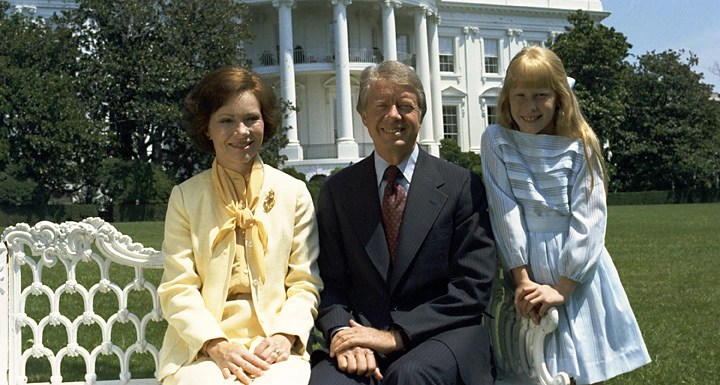
As I read his words, I felt a longing for a sense of the patriotism and pride I felt in 1976. And, as I listen to my playlists of the songs that personally informed my understanding of the world during Jimmy Carter’s presidency, I feel certain you will find a deeper understanding for my sentimentality around those years, regardless of whether your lifetime began before, concurrent with, or long after mine. Stevie Wonder sums it up perfectly, in the track “I Wish” from his 1976 album, Songs in the Key of Life, which I consider to be a great American masterpiece, a stunning, flawless time capsule of the state of American life in 1976.
Tonight, after I publish this brief Note, I plan to rewatch Jimmy Carter: Rock and Roll President and have a piece of chocolate cake to celebrate America’s longest living (and my favorite) President. If you have taken the time out of your life to read this Note, I believe you will also find the time to do your honest and earnest best to seek out unbiased, well-researched, and verified resources in preparation to fill out your ballots next month. This election carries more weight than any of my lifetime, perhaps of our country’s lifetime, and unbiased fact is harder to find than ever before. You probably won’t find it in your favorite social media feed. We no longer have the rich fiber of journalistic ethics to rely upon as a buffer from propaganda on the myriad of platforms offering skewed opinions disguised and delivered as investigative journalism. When I studied journalism, I learned about the importance of media literacy and critical thinking skills, which have become far more imperative than I could have possibly imagined when I was a college student in the early 1990s. I’ll leave it here, as I am not a journalist. I am simply a voracious reader of history, an ardent admirer of music, and a firm believer in liberty and justice for all.
 The Listening Gallery